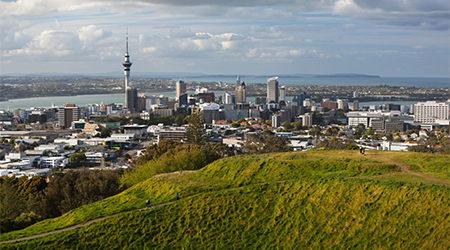

Recently I have come across an article at The Guardian (26.10.2017) regarding the planned ban on the foreign buyers to tackle an on-going housing crisis in the country. New Zealand’s quite young Prime Minister Jacinda Ardern has apparently showed her determination to stop the property speculators. In the recent years, New Zealand has become a favourite destination for the Chinese, Australian and Asian buyers as well as the world’s wealthy elite such as Peter Thiel (the co-founder of PayPal and a Facebook board member – he is also a Trump donor), Jack Ma (the man behind Alibaba). According to the article, there is a recorded boom in foreign buyers of land with an almost sixfold increase to 465,863 hectares in 2016 compared to the year before (this is equivalent to 3.2% of farmland in a country of 4.7 million population). This is the point the problems raise: affordability. A report by the Economist earlier this year showed that New Zealand had the most unaffordable house prices in the world with the prices in Auckland climbing 75% in the past four years (the market has recently slowed down though). The cost of owning a home increased by 10.4% in the year to the end of June, compared to a 2.8% increase in the UK. Prices in Wellington, the capital, soared more than 18% in the year to June. On 31st of October, another article has been published in the same line with the list of the world’s least affordable housing markets (Source: https://www.bloomberg.com/news/articles/2017-10-31/new-zealand-to-slap-home-buying-ban-on-foreigners-to-ease-market).
The case of New Zealand needs to be examined carefully to understand the actual motives behind the capital appreciation. Is it speculative or is it (f)actual? This case proves that lack of local demand, which is an essential factor for an actual appreciation, will create a ground for a speculative appreciation. In the light of this case if we look into the situation in Istanbul/Turkey market, we will have an opposite case. Housing Index in Turkey increased to 246.10 Index points in September from 244.50 Index points in August of 2017. Housing Index in Turkey averaged 169.19 Index points from 2002 until 2017.

Now let me give the latest statistics published from the Turkish Statistical Institute: In Turkey, house sales increased by 28.8% in September 2017 compared to the same month of the previous year and hence, became 140,298. For the house sales of September 2017, İstanbul had the highest share of house sales with 16.7% and 23,471 sold house. The followers of İstanbul were Ankara with 13,945 house sales and 9.9% and İzmir 7,575 house sales and 5.4%.

Source: http://www.turkstat.gov.tr/PreHaberBultenleri.do?id=24801
Here is the point: In house sales to foreigners became 2,236 by increasing 75.2% compared to the same month of the previous year. İstanbul was the first province with 797 sales in September 2017. This means out of 23,741 sold house only 797 have been bought by the foreign buyers and most importantly the prices have been dominated by the local drive and demand. I believe that this is the concrete and solid ground for the continuous capital appreciation.
Evren Erem, VIP Property