
|
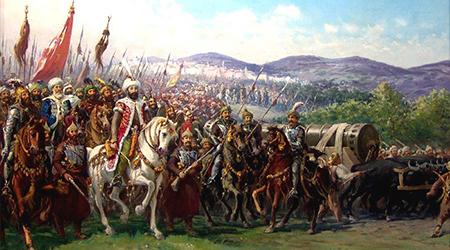
MUSLIM SIEGES OF ISTANBUL Istanbul had been a valuable target since the beginning of the military campaigns of the Muslims. First Muslim Arabs, then Muslim Turks launched numerous military campaigns against Istanbul, and besieged the city during some of those campaigns. It was rumored that Istanbul, which was known as “Kostantiniyyah” to Muslims, would be conquered by a righteous commander and soldiers. The first Muslim military campaign against Istanbul happened during the reign of Caliphate Uthman. Muawiya, the governor of Syria, prepared his navy for the first maritime campaign against Istanbul. This navy fleet beat the Byzantine navy and opened the sea passage to Muslims. Muslims conducted the first Istanbul siege in 668, during the reign of Muawiya, the Umayyad Sultan. The siege was continued until the spring of 669, but the army couldn’t conquer the city and epidemics killed many, soldiers and the army had to withdraw. Ebu Eyyub el-Ensari, the flag-bearer of the prophet Mohammed, was killed during this siege and buried at the bottom of the city walls. According to a popular rumor, his tomb was found by Sheikh Akshemseddin, who had visualised its location in his dream, during the conquest of the city by Sultan Mehmed the Conqueror. A mosque was later built at that location. After this first campaign, Muawiya sent the new navy in 673. The navy entered the Marmara Sea in 674, but the siege which took seven years was unsuccessful. Another siege, led by Maslama bin Abdu’l-Malik from August 716 to September 717 was also unsuccessful. He lost the majority of his troops at Istanbul front because of weather conditions, hunger, illnesses, and attacks by Bulgarian guerrillas. Some historical sources mention that the Emperor Leon III opened a mosque for Muslim prisoners of war at the request of Maslama and that he toured the city with Maslama after the siege was lifted. The last siege by Arabs occurred in 781-782 by the army under the command of Harun who was the son of the Sultan of Abbasid. Dynasty, el-Mahdi. Harun beat the Byzantine army at Izmit andreached Uskudar and besieged the city. He signed a treaty after the siege and returned back home. Harun ar-Rashid was then crowned as Abbasid Sultan and was honored with “ar-Rashid” title because of his Istanbul campaign. Besides these sieges there were also other campaigns waged by the muslim Arabs against Istanbul. OTTOMAN SİEGES OF ISTANBUL Ottoman Turks became interested in Istanbul during the l4th century. All residential areas of today’s Istanbul besides Surici (inside the city walls) became the territory of the Ottoman Empire way before the conquest. Ottomans also interfered with the internal affairs of Byzantine Empire during the same period of time. Manoeuvring around Istanbul continuously, they were getting prepared for the final cut Ottoman armies and reached the gates of Istanbul in 1340, but they did not lay siege. A strong Christian alliance stopped the campaign which was initiated by Sultan Murad I at Çatalca. The first big siege aimed to conquer Istanbul was realised by Sultan Yıldırım Bayezid. However, his army did not enter the city as a result of the agreement he made with the emperor. Sultan Yıldırım Bayezid influenced Istanbul afterwards, too. He managed to establish a Turkish square, a mosque and a court which gave trial to Turks. He would support the emperors who would take care of Ottoman interests. This was one of the most important factors the affected the conquest of Istanbul by Turks. The last siege attempt during the reign of Sultan Yıldırım Bayezid occurred in 1400. But the Timur problem interfered with this. The siege led by Musa Çelebi, the son of Sultan Yıldırım Bayezid, in 1411 was also unsuecessful. The Emperor, fearful of the sııccess of the Ottoman army, obtained the support of Çelebi Mehmed, brother of Musa Çelebi, from Bursa and the siege was lifted. Afterwards, during the reign of Celebi Mehmed there were no military campaigns against Istanbul. The last siege before the conquest occurred during the reign of Sultan Murad II The strategic planning phase of the siege took a long time, and it was very powerful strategic plan. But the siege was more difficult than the previous ones. The siege started on June 15, 1422 by 10,000 cavalry men with the blocking of the roads which connected Istanbul to other cities. Emir Sultan, one of the most powerful spiritual leaders of that time. came from ßursa and joined the army with his hundreds of dervishes. That positively affected the soldiers. The attack on August 24th, which Emir Sultan also participated in, was very intense, but not enough to conquer the city. The siege was lifted because of the rebellion of Shehzade Mustafa who was the brother of Sultan Murad II. This left the task of the conquest of Istanbul to the son of Sultan Murad II. ISTANBUL BEFORE THE CONQUEST Prior to the fall of Istanbul to the Ottomans, Byzantium had lost its status as a powerful empire: its land mass holdings had shrunk to the territories of Constantinople, Silivri Castle on the Marmara shore, and several small towns, such as Vize and Misivri. These sites were completely surrounded by the Ottomans, and the villages just beyond the Constantinople fonresses were left untouched by the Ottomans not because they were strong, but because they were considered insignificant. Constantinople was the target. The Byzantine emperors had accepted the sovereignty of the Ottomans and were paying tribute taxes to the Empire. In reality then, the Ottomans were dealing not with Byzantine emperors, but with minor Tekfurs (Byzantine princes). Irı essence, then, the domination of Byzantium was not that of an empıre and that Constantinople was more a religious center than the seat of an empire. It was the last and the most powerful stronghold of Chrístendom in the face of Islam and mounting Muslim military forces. To circumvent its fall, the Pope organised a new Crusade. However, having been stunned by Ottoman attacks, Byzantium’s most debilitating internal problem was exposed: the rift between Orthodox and Catholic Christians. This division led to insufficient assistance from Europe to defend the crippled Empire. In a desperate effort to unify, the factions, the Emperor and Patriarch gave in, and in 1439 at the Florence Council, knelt down, and offered their allegiance to the Catholic Church. Although a constrained one, this new alliance began an era of d’Etente between the Roman Orthodox and Catholic Church, who, with the eminent Ottoman threat, put aside their hundredyear – oId conflict and differences The formal celebration of the agreement was to become the subject of mass protests, however, as the people of Constantinople feared European involvement, and sought to defray the resurrection of another Latin era. After the Florence Council agreement, the powerful Crusade that was formed launched an attack on Rumeli in 1443 and 1444. However, the Ottoman victory at Varna was able to stop the tide of invading Crusaders. Varna was also the battle that determined the fate of Costantinople. Now, the conquest of the city became compelling for the young empire, who perceived Constantinople as an ailing element in the heart of Ottoman land. The decisive link between Rumeli and Anatolia spelt the fall of Constantinople and the rise of Istanbul. THE CONQUEST OF İSTANBUL Preparation for the conquest of Istanbul started only, one year ahead Iuge canons that were necessary for the siege were moulded. In 1452, Rumeli Castle was constructed to control the Bosphorus. A mighty fleet of 16 galleys was formed. The number of soldiers were doubled. The supply routes to Byzantine were taken under control. An agreement was made with Genoese to keep Galata impartial during the war. In Aprıl 1453, the first Ottoman frontier forces were seen in front of Istanbul. The siege was starting. The important points of the conquest are chronologically listed below. 6 April 1453: Sultan Mehmed pitched his imperial tent by• the door of Romanus in 9 April 1453: Baltaoğlu Süleyman Bey la unched the first attack to enter the Golden Horn gulf. 11 April 1453: The big fortresses were bombarded by cannon fires. Holes and cracks were opened here and there. Serious destruction inflicted by ceaseless bombardment 12 April 1453 The Ottoman fleet attacked the ships protecting the Golden Horn. The victory of the Christian ships decreased the morale of the Ottoman army. At the order of Sultan Mehmed, the Byzantine ships were pounded by mortar fire, and one galley was sunk. 18 April 1453, Night: The Sultan gave his first crucial order. The attack lasted four hours but it was scattered. 20 April 1453: A naval skirmish took place close to Yenikapi between the Ottoman fleet and four Byzantine war-ships with three supply ships full of food and weapons sent by the Papacy The Sultan came to the shore himself and ordered Baltaoğlu Süleyman Pasha to sink those ships by any means possible. The Ottoman fleet could not stop enemy’s ships which were bigger. With this failure the Ottoman army lost its morale and showed the signs of defeat. Ottoman soldiers staned defecting from the army. Soon, the Byzantizne Emperor wanted to take advantage of thís situation and offered peace. The offer, supported by famous Vizier Çandarlı Halil Pasha, was rejected by Sultan Mehmed. The siege and bombardment of the fortresses with cannons continued. During this chaos and widespread feeling of defeat, a letter from the Sultan’s spiritual teacher Akshemseddin promised good news about the conquest. Encouraged by this spiritual support, Fatih Sultan Mehmed, escalated the attaek, and decided to add an element of surprise: the Ottoman fleet anchored in Dolmabahce would be moved to Gold en Horn gulf land. The surprise appearance of the Ottoman fleet in the bay created panic among Byzantine residents of Costantinople. The fonresses on che shore of Golden Horn became a vulnerable spot and some of the Byzantine forces were moved there. This weakened the defence of the land fortresses. 28 April 1453: The attempt to burn the Ottoman ships in the bay was prevented by heavy, cannon fire. A bridge was constructed between Ayvansaray and Sütluce to attack the fortresses located on the shore of the bay An offer of unconditional surrender was delivered to the Emperor through the Genoese. If he surrendered he could have gone wherever he wanted and the life and property of his people would .have been spared. The Emperor rejected thzs offer. 7 May 1453: A three hour long attack was launched on the stream of Bayrampasa with a 30,000 strong force; but it was failed. 12 May 1453: A thunderous attack made towards the point between Tekfursaray and Edirnekapı was defeated by the Byzantine defence. 16 May 1453: When the underground tunnel dug in the direction of Eğrikapı intersected the Byzantinian underground tunnel, an underground skirmish erupted. The same day, an attempt to cut the sturdy chain blocking the entrance of the bay failed. The following day the attack was repeated, but again ended with failure. 25 May 1453: Fatih Sultan Mehmed, sent Isfendiyar Beyoğlu ismail Bey as an ambassador offering him to surrender for the last time. According to this offer, the Emperor and his followers could take their wealth and go anywhere they wished. The people who decided to stay could keep their belongings and estates. This offer too was rejected. 26 May 1453: According to rumors European countries and especially Hungarians were planning to mobilise their troops to help the Byzantines unless the siege was ended. Upon hearing these rumors Sultan Mehmed gathered his war council. In the meeting Çandarlı Halil Pasha and his party defended their previous position, that is, of putting an end to the siege. Sultan Mehmed with his tutor Zağanos Pasha, his teachers Akşemseddin, Molla Gızrani and Molla Hızsrev opposed the idea of quitting. They decided to continue the war and Zağanos Pasha was commissioned for preparations. 27 May 1453: The general attack was announced to the Ottoman army 28 May 1453: The army, spent the day by resting and preparing for the next day’s attack. There was a complete silence among soldiers. Sultan Mehmed inspected the army and encouraged them for the great attack. On the other side, a religious ceremony was held in Haghia Sophia Church. The Emperor urged people to participate in the defence. This would be the Iast Byzantine ceremony. 29 May 1453: Platoons positioned for the assault. Sultan Mehmed gave the order to attack at midnight. Inside Constantinople, while the soldiers positioned for war, people filled rhe churches. The Ottoman army launched its final assault accompanied by commemoration of God and beats of drums. The first assault was performed by infantry and it was followed by Anatolian soldiers. When 300 Anatolian soldiers were martyred, the Janissaries staned their attack. With the presence of Sultan Mehmed, the Ottoman army was motivated and cbest to chest fights started. Meanwhile the young soldier called Ulubatlı Hasan who first erected the Ottoman flag on Byzantine land fortresses was martyred. Upon the entrance of the Janissaries from Belgradkapı and the surrender of the last defenders in Edimekapı front, the Byzantine defence collapsed. Abandoned by his soldiers, the Emperor was killed during street skirmishes. Turkish forces entered from every direction and crushed the Byzantine defence completely Towards noon Sultan Mehmed entered the city He went directly to Haghia Sophia Church and convened it to mosque. CONSEQUENCES OF THE CONQUEST The conquest of Istanbul has had such a historical impact on the Turkish and Muslim world to the degree that some historians demarcate the end of the Middle Ages with the city’s conquest. With the siege of Istanbul, the Ottomans proceeded to establish hegemony over numerous independent Turkish states (Beylik) within Anatolia (Asia Minor). The result of imperial conquest was to unify the Turkish populations in Anatolia. In tum, other non-Turkish, Muslim communities and principalities were brought together under the aegis of Ottoman leadership so that the Ottoman Beylik would eventually expand into an Empire. After the conquest, Ottoman Muslims were to take dynamic roles in shaping international politics. Up until that point, European Chrìstendom had, for three centuries, striven to evict Muslims from Asia Minor, with Istanbul functioning as a border station for the Crusaders. After the conquest, however, the sovereignty of Asia Minor Muslims was assured, and they were no longer threatened by the Crusaders. Indeed Muslims would eventually begin European campaigns, so that the conquest of Istanbul became a historic turning point vis a vis proving superiority over Europe. A second critical component in Istanbul’s signiEicance to world events and history is its relationship to the Renaissance. After its conquest, many Byzantine artists and philosophers emigrated to European centers-mostly Rome taking with them valuable manuscripts regarding advanced ıntellectual developments. These intelligentsia were instrumental in the movement to revive and revise classical Greek culture. The clash and reunification of the two divergent schools sparked the ideological revolution known as the European Renaissance, and Byzantine intellectuals from Istanbul were pivotal agents in catalysıng the movement. MEHMED THE CONQUEROR The seventh Ottoman Sultan, Sultan Mehmed, the conquerror acceded to the throne twice-in 1444 and 1451-reigning for a total of 31 years. In his youth, Prince Mehmed received a privileged edu cation, trained by the most pre-eminent scholars of his time. Among them Molla Yegan, Akşemseddin, Molla Gürani, and Molla Ayas. In accordance with the royal tradition, in order to provide him the experience required for ruling the entire state, he was appointed governor of Manisa. Concomitantly, he was schooled in the fields of mathematics, geometry, textual analysis of the Quran, religious jurisprudence, theological philosophy, and history He learned Arabic, Persian, Latin, Greek, and the Serbian languages. Because of the perception that the office would be. vulnerable with a boy-king, European states began organising campaigns along the Ottoman borders, coalescing as the Crusade to evict the Ottomans from Europe Declaring himself chief commander of the Ottoman army, Sultan Murad II fought a decisive and bloody battle at Varna and defeated the Crusaders. With the victory Sultan Murad II reassumed executive leadership, sending prince Mehmed back to Manisa to continue his rigorous training. With the death of his father, Sultan Mehmed came to the capital city of Edirne in order to accede a second time to the throne. His very first pruject as Sultan was to fulfill his dream of conquering Istanbul-a plan that had engaged him during his stint at Manisa. His strategy was as follows. First, he erected a fortress known as Rumeli Castle, across from the Anatolia Castle, on the European side of Istanbul. He had been stockpiling an entire fleet of gigantic canons from various European states, and once sufficiently equipped, he decided he would lead the army himself on the day of attack. After succeeding in the conquest of Istanbul, he turned to expanding control of European lands to the River Danube, and took on the matter of the Serbian problem. Regarding the latter, he managed to convince the Serbs to accept Ottoman domination. He continued with assaults on Genoese lands and conquered Amasra, an important military base, and Kefe, a commercial port. He set his sights on the two capital cities on the Black Sea: he ended the Çandaroğulları rule by taking Sinop; the Pontus rule ended once he conquered Trabzon. He proceeded to add the Midilli Island as part of Ottoman land, completed the conquest of Bosnia Herzeg,ovina, and united the Balkans south of the River Danube. SULTAN MEHMED THE CONQUEROR AS A STATESMAN AND A SCIENTIST Mehmed II, referred to as Fatih or “the Conqueror,” was responsible for the Ottoman state’s development into a true imperial power after having accomplished the great feat of conquering Constantinople in 1453. This Ottoman Sultan had received a most rigorous education, not only in the Islamic ans and sciences but also in the western tradition, and thus was well trained as the future imperial ruler of the Ottoman Empire. As a military commander, he possessed extraordinary talent, managing an exceedingly disciplined and well-organised army He was renowned for the complete secrecy with which he guarded all military tactics and campaigns, divulging nothing, even to his closest cohorts. He was the first Ottoman Sultan to pay substantive attention to artillery Before Sultan Mehmed the conquerror, canon were deployed solely as a means to frighten the enemy by virtue of their thunderous booms; in other words, their destructive power and the critical role they would assume in warfare went entirely unacknowledged. Realising their perspective power, Sultan kaynak:http://www.ibb.gov.tr/SITES/KS/EN-US/0-EXPLORING-THE-CITY/HISTORY/Pages/ConquestandIstanbul.aspx |
document.getElementById(‘dcd5f8de’).style.opacity–;