
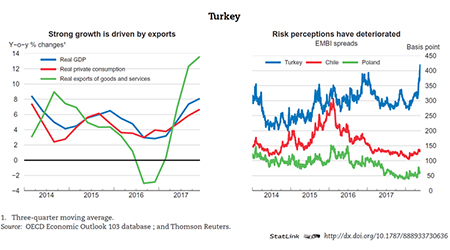

Following a strong recovery in 2017 and turbulence in spring 2018, economic growth is set to slow but to stay around 5% in 2018 and 2019. The uncertainties surrounding the early elections in June, as well as persisting regional geopolitical tensions, create risks. The exchange rate remains highly volatile, with the lira depreciating substantially recently despite a significant increase in the policy interest rate, and consumer price inflation is far above target. Disinflation is projected to be slow. A credible macroeconomic framework is of utmost importance to uphold confidence in this sensitive environment.
The Medium-Term Economic Programme provides a prudent fiscal framework, and recent monetary tightening should be backed with stronger institutional credibility of monetary policy. Structural reforms to align the business environment with international good practices should be stepped up as soon as possible to rebalance growth and make it more inclusive.
Growth has been backed by strong exports and government support
Real GDP growth in 2017 and early 2018 exceeded both market expectations and official projections. Robust foreign demand and real exchange rate depreciation have supported exports. Fiscal and quasi-fiscal stimulus, including a massive extension of the government credit guarantee scheme, have boosted domestic demand. Stimulated by new employment incentives, 1.6 million net new jobs were created in 2017, but strong labour force growth kept unemployment close to 10% as of early 2018. Private investment was subdued over most of the recent period, reflecting “wait and see” attitudes of investors amid various domestic, regional and international uncertainties. Yet, on the back of brightening export prospects and hefty government incentives, investment picked up in late 2017 and the share of machinery and transport equipment investment in GDP returned to its long-term average of around 13%, one of the highest rates in the OECD.
 Increased imbalances and uncertainties call for a credible macroeconomic framework
Strong growth has amplified Turkey’s longstanding imbalances, which arise from excessive reliance on domestic demand. The current account deficit is estimated to have surpassed 6% of GDP in early 2018 and foreign financing needs are projected to reach 25% of GDP in 2018. Oil price increases have put additional pressure on the current account and external funding will become less abundant and more costly as advanced OECD economies normalise monetary policy. Fiscal policy has added to the imbalances. Spending pressures increased strongly in spring 2018, owing to new business incentives and further social transfers.
Early elections in June 2018 create room for post-electoral consolidation in line with the government’s Medium-Term Economic Programme. The fiscal position should be reported fully and transparently, with timely quarterly general government accounts according to international standards. The commitment of the central bank to the official 5% inflation target is in question after several years of overshooting and five consecutive quarters of double-digit inflation. This exacerbated exchange-rate depreciation and volatility, considerably increased the country’s risk premia, and heightened risks associated with external debt. Against this backdrop, the central bank increased its lending rate by a cumulative 375 basis points in April and May this year.
To strengthen monetary policy credibility, the commitment to the central bank’s independence and to the inflation target should be reinforced. Monetary policy should be simplified, and forward guidance should be provided on how the authorities plan to hit the 5% inflation target in the foreseeable future.
Growth is set to slow and could further decline if tensions intensify
On the back of strong positive carry-over from late 2017 and early 2018, absent any further severe tensions on exchange rates and risk premia, and assuming no new disturbances in international capital flows as advanced economies normalise economic policies, GDP growth is projected to stay around 5% in 2018 and 2019. If the electoral process concludes without major tensions, fiscal and monetary policies do not remain pro-cyclical, and ambitious but delayed structural reforms are phased in after the elections, consumer and investor sentiment may improve and growth may be stronger.
If confidence weakens following additional uncertainties regarding the macroeconomic policy stance or the outlook for structural reform after the elections, or as a result of further tensions in financial markets and exchange rates, capital movements and domestic sentiment may weaken investment, consumption and growth.